Friday, 2 June 2017

7 AMAZING BENEFITS OF DRINKING WATER FIRST THING IN THE MORNING!

DEAL WITH A HEADACHE
The human brain is made up of 85% water. So, if there is the absence of enough water in the brain, it can lead to serious headaches. You can drink water in the morning to stop these aches.

IT REHYDRATE YOUR BODY
When you wake up after a sleep marathon, your body will be dehydrated. No matter the amount of water you drank the previous day, your body will still lack water in the morning.

EASE MENSTRUAL PAIN
Every month, women suffer from cramps which can sometimes be unbearable. Drinking water helps to reduce the water retention in the vagina which causes cramps thus easing the pain.

REDUCE ARTHRITIS
Your joints are filled out with fluid that can increase or decrease depending on your water intake. This fluid also reduces due to tough activities and ageing. Drinking water in the morning helps your body to restore fluid so that your joints can move freely.

BOOST YOUR KIDNEY HEALTH
A kidney stone is a hard, crystalline mineral material formed within the kidney or urinary tract. Kidney stones are a common cause of blood in the urine and often severe pain in the abdomen. You can tackle kidney stone by downing lots of water, especially in the morning.

IT’S ABSOLUTELY REFRESHING
Gulping water after you wake up in the morning is absolutely refreshing and makes you feel good.

GET RID OF UNUSABLE TOXINS
Water can assist in flushing toxins (a toxin is anything that damages the body) out of your body. This is because while you are asleep your body cleans itself, restores lost energy and balances hormones. After the cleanup, toxins and other waste materials will be released and wait to be flushed out. So, to clear these toxins, you should drink water in the morning.

Have a wonderful day!

Share with others and save a Life.
www.reindzstar.blogspot.com

Thursday, 23 March 2017

News Paper Publication

News Paper Publication

We are very proud of our good team, Fit4Life Live4Life is being published on The Province Newspaper. #BetterDaysAhead. 

Sunday, 19 March 2017

PROSTATE HEALTH


MEN - MY CHILDHOOD; MY MANHOOD; MY PROSTATE.

Is Prostate strictly for Men?

Yes, ONLY men have prostate and ONLY men over 40years but the healthcare enlightenment is for everyone. There is no woman who does not know a man 40 years and above – Father, Uncle, Brother, Son, Friend, Neighbor, Colleague …

Essentially what I will be doing today is health promotion. Responsible health promotion must provide three things:

1. Information

2. Reassurance

3. A Plan of Action.

Let me start with a background on Prostate Health.

Everyone has a pair of kidneys. The job of the kidney is to remove waste. It is the LAWMA (waste management company) of your body. Everyday your blood passes through the kidney several times to be filtered. As the blood is filtered, urine is formed and stored in a temporary storage tank called the urinary bladder.

If there were to be no urinary bladder, as a man walks on the road, urine will be dropping.

Now think of the plumbing work in your house. Think of the urinary bladder as the overhead storage tank. From the storage tank, a good plumber will run pipes to other parts of the house, including the kitchen. God in His wisdom ran pipes from our urinary bladder to the tip of the penis. The pipe is called the urethra. Just below the bladder and surrounding the urethra is a little organ called the prostate gland.

The prostate gland is the size of a walnut and weighs about 20grams. Its job is to make the seminal fluid which is stored in the seminal vesicle. During sexual intercourse, seminal fluid comes down the urethra and mixes with the sperms produced in the testicles to form the semen. So semen technically is not sperm. It is sperm + seminal fluid. The seminal fluid lubricates the sperm.

After age 40, for reasons that may be hormonal, the prostate gland begins to enlarge. From 20 grams it may grow to almost 100 grams. As it enlarges, it squeezes the urethra and the man begins to notice changes in the way he urinate.

If you have a son under 10, if he has a little mischief like we all did at that age, when he comes out to urinate, he can target the ceiling and the jet will hit target. Call his father to do same, wahala dey. His urine stream is weak, cannot travel a long distance and sometimes may come straight down on his legs. So he may need to stand in awkward position to urinate.

Not many men will be worried their urine stream cannot hit the ceiling. Toilets are on the floor and not on the ceiling. But other symptoms begin to show.

TERMINAL DRIPPLING:

The man begins to notice that after urinating and repacking, urine still drops on his pants. This is the reason why after an older man urinates, he has to ring bell. A younger man simply delivers to the last drop and walks away. Just see an older man coming from the bathroom. Sometimes he may clutch the newspaper closely to hide the urine stains, particularly on plain colored trousers.

HESISTANCY

At this point you wait longer for the urine flow to start. There are 2 valves that must open for you to urinate – the internal and external sphincters. Both open but because of obstructions in the urethra, you wait long for the flow to start.

INCOMPLETE EMPTYING

You have this feeling immediately after urinating that there is still something left.

As all these things happen, the bladder begins to work harder to compensate for the obstruction in the urethra. The frequency of urination goes up. Urgency sets in. sometimes you have to practically run into the toilet. Nocturia also becomes common. You wake up more than 2 times at night to urinate. Your wife begins to complain.

Men being men may not talk to anyone even at this point. Then the more serious complications start.

Stored urine gets infected and there may be burning sensation when urinating.

Stored urine forms crystals. Crystals come together to form stone either in the bladder or in the kidney. Stones may block the urethra.

Chronic urinary retention sets in. The bladder stores more and more urine. The size of the bladder is 40 - 60 cl. A bottle of coke is 50cl. As the bladder stores more urine it can enlarge up to 300cl. An overfilled bladder may leak and this leads to wetting / urinary incontinence. Also the volume may put pressure on the kidney and may lead to kidney damage.

What may likely bring the man to hospital is acute urinary retention. He wakes up one day and he is not able to pass urine.

Everything I have described above is associated with prostate enlargement, technically called benign prostate hyperplasia.

There are other diseases of the prostate like:

1. Prostatitis – inflammation of the prostate

2. Prostate cancer – cancer of the prostate.

This discussion is on prostate enlargement.

I have bad news and good news.

The bad news is that every man will have prostate enlargement if he lives long enough.

The good news is that there are life style changes that can help the man after 40 to maintain optimum prostate health.

Nutrition

Look at what you eat. 33% of all cancers, according to the US National Cancer Institute is related to what we eat.

Red meat everyday triples your chances of prostate disease. Milk everyday doubles your risk. Not taking fruits / vegetables daily quadruples your risk.

Tomatoes are very good for men. If that is the only thing your wife can present in the evening, eat it with joy. It has loads of lycopene. Lycopene is the most potent natural antioxidant.

Foods that are rich in zinc are also good for men. We recommend pumpkin seeds (ugbogulu).

Zinc is about the most essential element for male sexuality and fertility.

Men need more zinc than women. Every time a man ejaculates he loses 15mg of zinc. Zinc is also important for alcohol metabolism. Your liver needs zinc to metabolize alcohol.

ALCOHOL CONSUMPTION

As men begin to have urinary symptoms associated with prostate enlargement, it is important they look at alcohol consumption. More fluid in means more fluid out.

Drink less. Drink slowly.

EXERCISE

Exercise helps build the muscle tone. Every man should exercise. Men over 40 should avoid high impact exercise like jogging. It puts pressure on the knees. Cycling is bad news for the prostate. We recommend brisk walking.

SITTING

When we sit, two-third of our weight rests on the pelvic bones. Men who sit longer are more prone to prostate symptoms. Do not sit for long hours. Walk around as often as you can. Sit on comfortable chairs. We recommend a divided saddle chair if you must sit long hours.

DRESSING

Men should avoid tight underwear. It impacts circulation around the groin and heats it up a bit. While the physiological temperature is 37 degrees, the groin has an optimal temperature of about 33 degrees. Pant is a no - no for men. Wear boxers.  Wear breathable clothing.

SMOKING

Avoid smoking. It affects blood vessels and impact circulation around the groin.

SEX

Regular sex is good for the prostate.

Celibates are more prone to prostate illness. While celibacy is a moral decision, it is not a biological adaptation. Your prostate gland is designed to empty its contents regularly.

Thought: when someone share something of value with you and you benefit from it. You have a moral obligation to share it with others because someone might be saved.

Monday, 13 March 2017

10 Benefits of Your Child's Physical Activity

When many people decide to "get fit," they assume it involves rigorous activity. But you don't have to spend hours in a gym to be physically active. People can get in shape by performing everyday activities in the home. Every time you and your child throw a softball, swim a lap, climb a flight of stairs, walk to the store, or carry packages, your health and fitness levels are improving.

When someone is physically fit, he or she feels and looks better, and they stays healthier. The earlier a child starts getting in shape, the more he/she'll reduce her risk of numerous illnesses.

Here are some of the benefits that physical activity offers your child:

1. It strengthens the heart. The heart is a muscle. Like other muscles, its performance improves when it's regularly challenged by exercise. The heart responds to exercise by becoming stronger and more efficient. Strengthening the heart muscle can help ward off heart disease.

2. It helps keep arteries and veins clear. Exercise reduces the amount of harmful cholesterol and fats in a person's blood. It increases the flexibility of the walls of blood vessels, and helps to lower blood pressure. This can reduce a person's risk for heart attack and stroke.

3. It strengthens the lungs. Working hard increases lung capacity, and their efficiency in moving air in and out of the body. As a result, more oxygen is drawn into the body and more carbon dioxide and other waste gases are expelled. Regular exercise helps prevent the decline in oxygen intake that occurs naturally with age or as a result of inactivity.

4. It reduces blood sugar levels. Exercise prevents sugar from accumulating in the blood by triggering muscles to take up more glucose from the bloodstream and use it for energy. This can reduce a person's risk of developing diabetes.

5. It controls weight. When a person is sedentary, he tends to be taking in more calories than are needed. These unused calories accumulate as fat. A person who is physically active may have a deficit of calories, which takes fat away and lowers weight. Lowered weight is good for the heart and can be beneficial in people with diabetes.

6. It strengthens bones. Just as muscles grow stronger when physically stressed, bones also respond by getting stronger. Exercise increases bone density, which helps prevent osteoporosis, a condition in which bones lose density, weaken, and become porous and fragile.

7. It helps prevent cancer. People who exercise regularly have lower incidences of cancer. The cancers most affected include colon, prostate, uterine, and breast cancers.

8. It regulates blood pressure. Exercise has been shown to reduce stress levels. As the levels of stress in a person's body subsides, his blood pressure and his risk for heart disease decline.

9. It improves energy levels. Regular exercise often makes people feel more energetic, allows them to be more active, and reduces the likelihood that they'll tire during the day.

10. It enhances emotional well-being. Most people report that they feel calm and have a sense of well-being after they exercise. Exercise, according to one theory, releases beta-endorphin, a natural substance in the body that is hundreds of times more potent than morphine. Another theory points to serotonin as the cause of the exercise high. Increased levels of serotonin in the central nervous system are associated with feelings of well-being, heightening of appetite, and lessening of mental depression. The weight loss that accompanies exercise can also cause people to feel better about themselves.

Sources: American Academy of Pediatrics; American Medical Association; U.S. Department of Health and Human Services

Reviewed
13/03 by Olayinka Ajibola , Director of Operations / Fitness Expect @ Kc Gym & Fitness Centre.

All content here, including advice from doctors and other health professionals, should be considered as opinion only. Always seek the direct advice of your own doctor in connection with any questions or issues you may have regarding your own health or the health of others.

Friday, 27 January 2017

9 Science-Backed Reasons Why You Should Go to Bed Early

Show of hands if you’ve ever stayed up way too late texting with friends, catching up on TV shows. Yep, plenty of us are guilty as charged — and as a result, we end up feeling exhausted in the morning.
That most Nigerians are falling short on getting the recommended eight hours of sleep per night is nothing new. Clearly though, not everyone who fails to log enough shut eye actually has trouble sleeping. Plenty of us are just staying up too late or putting off bedtime in favor of other activities.
But over time, staying awake into the wee hours can come with a hefty cost. Here are nine surprising ways you can benefit from ditching, or at least minimizing, your night owl habit.

1. You might worry less.
Remember when Mom used to tell you that it would all seem better in the morning? She was right! Compared to people who turn in early, those who go to bed very late are more likely to be overwhelmed with repetitive negative thoughts, found one study published late last year.
The findings suggest that sleep disruption could actually be linked to the development of pessimistic thoughts. On the bright side? Psychologists suggest that focusing on good sleep habits can help. Sure, going to bed early won’t get rid of whatever problems you’re dealing with — but now, we know that it really may help to put them in perspective, and a well-rested mind is better at dealing with emotions and problem solving.

2. You could get along better with everyone.
Been getting into a lot of arguments lately? There’s one easy way to fix that.
Too little sleep tends to leave people feeling
short-tempered, irritable, and stressed . Which means that little things that might not normally be a big deal can cause you to fly off the handle. The result? More spats and misunderstandings with those around you.
Being well-rested, on the other hand, will help to recalibrate your baseline. You’ll naturally feel more optimistic, patient, and relaxed (even if nothing around you has actually changed), which means you’ll have an easier time coping with all of life’s little curveballs.

3. You can have a safer commute...
It’s scary to think about, but sleep deprivation can make you less alert and significantly up your likelihood of getting into a car crash. And tons of us are at risk:
Roughly 60 percent of adult drivers say they’ve driven a vehicle while feeling drowsy in the last year. Even crazier? More than a third say that they’ve actually fallen asleep behind the wheel.
According to AAA Foundation reports , people who sleep six to seven hours are twice as likely to have a car accident compared to those who sleep for 8 hours or more. People who sleep for five hours or less increase their risk up to five-fold. Go for 24 hours without sleeping, and your skills behind the wheel are the same as someone who is legally drunk.

4. ... and be more productive at work.
We’ve all been there. You’re sitting at your desk after a super late night, staring blankly at the report that’s supposed to be due at noon — and nothing’s happening. That’s because lack of sleep messes with your cognition, making it harder for your brain to perform basic functions like concentrating and remembering .
And it’s not just the straightforward stuff that suffers. Lack of REM sleep — the sleep that occurs when you dream — can thwart creative-thinking skills. In fact, one recent study found that subjects performed 30 percent better on a puzzle after waking up from REM sleep than after waking up from non-REM sleep. Research has shown that sleep is essential for helping people solve complex problems , too.
Get your eight hours of snooze time, and the brain boost that follows will leave you feeling fresh, focused, and ready to take care of business. Report due at noon? You’re on it.

5. You might have an easier time maintaining a healthy weight.
Research suggests that the less sleep you get, the more likely you are to be overweight or obese. How so? When you’re regularly sleep deprived, you have less energy to exercise or make healthy food choices.
Plus, studies show that the later you stay up, the more you eat: Our body’s internal clocks seem to be hard-wired to prefer salty, fatty, or sugary foods after 8 p.m. Which might explain why night owls who stay up until 4 a.m. eat about
550 more calories than early birds who go to sleep at 10 p.m.

6. You could be one of those people who doesn’t get sick this winter.
Next to washing your hands, getting enough sleep might be one of the most effective ways at avoiding a cold or the flu.
Adequate shuteye keeps your immune system strong, so you’re less likely to catch a case of whatever is going when you’re exposed to it (hello, sneezing co-worker!). And if you do manage to get sick, you’ll recover faster. In other words, your cough or sniffles will last a few days rather than lingering for the next three months.

7. You might look better.
A recent Swedish study confirmed what most of your friends are too polite to tell you: When you don’t get enough sleep, you don’t look so great. When participants viewed images of people who were sleep-deprived or well rested, the sleep-deprived folks were rated as less attractive, less healthy, less approachable, and sadder.
During sleep, your body works to replace tired old cells with fresh new ones, helping your complexion to look more glowy than ghastly.
Lack of sleep can also contribute to puffy, darker eyelids, red eyes, and a paler complexion that practically screams, I’m running on fumes.

8. You can lower your risk for scary diseases.
Want to lower your chances for developing
chronic conditions like heart disease, kidney disease, high blood pressure, diabetes, and stroke? In addition to eating right and exercising, be vigilant about getting enough sleep.
While you snooze, your body is hard at work performing repairs on your heart, blood vessels, brain and other tissues that help keep chronic disease at bay. Skimp on sleep, and that nightly maintenance schedule starts to suffer. Eventually, your parts will start to wear out, setting the stage for major problems.

9. You won’t feel the need to hit the snooze button three times. (Well, maybe.)
If you just can’t stand getting out of your warm, cozy bed, no amount of sleep will make you the kind of person who bounds out of bed in the morning. But once you do get on a regular sleep schedule and maintain a well-rested baseline, waking up becomes much less challenging.
It’s a lot easier to deal with the morning when you’re feeling refreshed, and you may even find you don’t need an alarm at all when your body gets adequate rest. Seriously, go ahead and try it!
If falling asleep early doesn’t come easy for you, try using strategies like taking a warm bath or practicing guided relaxation near bedtime. Part of good sleep hygiene is keeping a regular pre-bed routine, as this helps mentally and physically prepare you for snoozing. Turning electronics off and keeping rooms cool are also smart moves.

Healthy Lifestyle and More.

Sunday, 1 January 2017

New Year Resolution, Healthier You!


New Year, Healthier You

New Year’s resolutions are a bit like babies: They’re fun to make but extremely difficult to maintain.
Each January, roughly one in three persons resolve to better themselves in some way. A much smaller percentage of people actually make good on those resolutions.

While about 75% of people stick to their goals for at least a week, less than half (46%) are still on target six months later.

It's hard to keep up the enthusiasm months after you've swept up the confetti, but it's not impossible. This year 2017, pick one of the following worthy resolutions, and stick with it. Here’s to your health!

Lose Weight
The fact that this is perennially among the most popular resolutions suggests just how difficult it is to commit to. But you can succeed if you don’t expect overnight success. "You want results yesterday, and desperation mode kicks in," says Olayinka Ajibola, CEO of Reindz Star Concepts (Owner of Kc Gym Centre & Fit4Life Live4Life Event). "Beware of the valley of quickie cures."

Also, plan for bumps in the road. Use a food journal to keep track of what you eat and have a support system in place. "Around week four to six...people become excuse mills," Olayinka says. "That’s why it’s important to have someone there on a regular basis to get you through those rough times."

Stay In Touch
It’s good for your health to reconnect with friends and family. Research suggests people with strong social ties live longer than those who don’t.
In fact, a lack of social bonds can damage your health as much as alcohol abuse and smoking, and even more than obesity and lack of exercise.

In a technology-fixated era, it’s never been easier to stay in touch—or rejuvenate your relationship—with friends and family, so fire up Facebook and follow up with in-person visits.

Quit Smoking
Fear that you’ve failed too many times to try again? Talk to any ex-smoker, and you’ll see that multiple attempts are often the path to success.

Try different methods to find out what works. And think of the cash you’ll save! (We know you know the ginormous health benefit.)

Save Money
Save money by making healthy lifestyle changes. Walk or ride your bike to work. (That means more money in your pocket and less air pollution.)

Cut back on gym membership costs by exercising at home. Many fitness programs on internet, download and workout with it.

Take stock of what you have in the fridge and make a grocery list. Aimless supermarket shopping can lead to poor choices for your diet and wallet.

Cut Your Stress
A little pressure now and again won’t kill us; in fact, short bouts of stress give us an energy boost. But if stress is chronic, it can increase your risk of—or worsen—insomnia , depression,
obesity, heart disease, and more.

Long work hours, little sleep, no exercise, poor diet, and not spending time with family and friends can contribute to stress, says Olayinka MD.
"Stress is an inevitable part of life," he says. "Relaxation, sleep, socializing, and taking vacations are all things we tell ourselves we deserve but don’t allow ourselves to have."

Volunteer
We tend to think our own bliss relies on bettering ourselves, but our happiness also increases when we help others.

And guess what? Happiness is good for your health. Other research suggests that positive emotions can make people more resilient and resourceful.
"Someone who makes this sort of resolution is likely to obtain a tremendous personal benefit in the happiness department".

Go Back To School
No matter how old you are, heading back to the classroom can help revamp your career, introduce you to new friends, and even boost your brainpower.

A 2007 study found that middle-age adults who had gone back to school (including night school) sometime in the previous quarter century had stronger memories and verbal skills than those who did not. What’s more, several studies have linked higher educational attainment to a decreased risk of Alzheimer’s disease.
"You are gaining a sense of accomplishment by gaining new knowledge, and you are out there meeting people and creating possibilities that were never there before," Olayinka says.

Cut Back On Alcohol
While much has been written about the health benefits of a small amount of alcohol, too much tippling is still the bigger problem. (In fact, binge drinking seems to be on the rise.)

Drinking alcohol in excess affects the brain’s neurotransmitters and can increase the risk of depression, memory loss, or even seizures.
Chronic heavy drinking boosts your risk of liver and heart disease, hypertension, stroke, and mental deterioration, and even cancers of the mouth, throat, liver, and breast.

Get More Sleep
You probably already know that a good night’s rest can do wonders for your mood—and
appearance. But sleep is more beneficial to your health than you might realize.

A lack of sleep has been linked to a greater risk of obesity and type 2 diabetes. And sleep is crucial for strengthening memories (a process called consolidation).
So take a nap—and don’t feel guilty about it.

Happy New Year
Happy 2017

How Does Obesity Cause Cancer? Three Leading Theories


This blog post was originally published on the Cancer Research UK science blog. It’s reposted here with minor edits by OLAYINKA Ajibola, C.E.O of Kc Gym & Fitness Centre.

‘Love handles’, ‘muffin top’, ‘beer belly’, ‘extra padding’, ‘cuddly bits’, ‘winter insulation’… We all have names for the squishy bits we keep meaning to lose – but apart from not fitting into our favorite jeans & wears,  carrying too much weight isn’t actually doing any harm, is it?

Unfortunately, it is. But despite efforts to raise the profile of the link, public awareness remains stubbornly low. This is an urgent problem: the world is slowly drifting into an obesity crisis, with the condition already linked tonearly 500,000 cancer cases worldwide every year.

According to recent reports, public health experts predict that – shockingly – in the US obesity will soon overtake tobacco as the leading preventable cause of cancer.

So it’s clear that those spare pounds/weight aren’t a mere overflow parking lot for excess donuts.

But that raises a crucial question: how exactly does fat increase our risk of cancer?

While there are several plausible explanations, it’s an answer that researchers are still working hard to figure out. But first… just what is fat?

Fat isn’t just padding: it’s like another organ

Fat (also known as adipose tissue) has two main roles in the body.

Primarily it exists to store calories in the form of chemicals called lipids, which – when food was scarce would serve as a back-up energy store to keep us going. But nowadays many people consume more calories than they use up, leading to more of us becoming overweight or obese.

But the fat in your body also has a secondary function – it’s essentially a huge gland, sending out a constant stream of biological information and instructions that affect the rest of your body. This helps control processes like growth, metabolism and reproductive cycles.

But because of their ability to turn biological processes on and off, the signals produced by fat have a darker side when it comes to cancer.

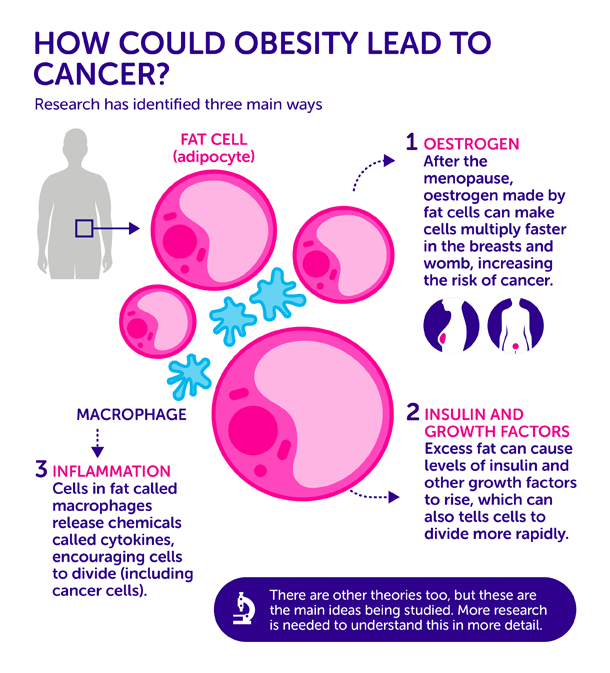
This is especially true when people become overweight or obese – the point at which excess fat has a negative impact on health. Here are the three leading theories about how excess fat might lead to cancer, and the scientific evidence behind each one.

Infographic credit Cancer Research UK

1. The estrogen connection

One of the strongest links between obesity and cancer is an increased risk of breast and womb cancers in womenwho are overweight or obese after the menopause, and this relates to higher estrogen levels.

In pre-menopausal women, the ovaries are the main estrogen-producing cells. But fat cells can make estrogen too and, after the menopause, when the ovaries stop working, fat becomes the chief source of the hormone. And there is solid evidence showing that being obese leads to higher estrogen levels in women after the menopause.

Professor Martin Wiseman, a leading expert on diet, weight and cancer from the World Cancer Research Fund, is in no doubt that estrogen made by fat cells is a leading culprit in postmenopausal breast and womb cancer.

“The evidence that estrogen plays a central role in some cancers is black and white. Estrogen makes certain cells – like breast and womb cells – divide, so too much estrogen can encourage cells to keep dividing when they shouldn’t be. And uncontrolled cell division is fundamentally what cancer is.

“Large studies of women have shown a direct relationship between obesity, high estrogen levels and breast and womb cancers”, he explains, “and understanding this relationship has been critical in developing effective treatments – like tamoxifen andaromatase inhibitors – that work by cutting off estrogen.

“Furthermore, if women at high risk of breast cancer are given estrogen-blocking treatments, fewer go on to develop the disease. Cutting off estrogen can stop breast cancer developing.”

While the link to women’s cancers is stronger, there’s also data suggesting that obesity-related changes in sex hormones can play a role in men’s cancers too. There’s evidence that, while rare, breast cancer in men is linked to increased estrogen caused by excess body fat. Obesity is also linked to higher rates of aggressive prostate cancer, but it’s unclear if changes in estrogen from fat cells play a role, or whether it could be down to changes in testosterone, the male sex hormone.

2. Metabolic chaos

The chemical processes going on constantly throughout the body – collectively known as metabolism – are complicated and tightly controlled, relying on a finely tuned web of information flowing between cells and organs.

But the chemical signals produced by fat cells means that obesity can cause a major upset to this balance, and this is thought to be another way it makes cancer more likely.

One key hormone that acts as a master-controller of metabolism is insulin. It’s made by the pancreas and orchestrates how cells take up and process glucose from the blood.

But insulin’s instructions can be overridden by chemicals in your blood known as free fatty acids – the levels of which can be affected by eating a fatty meal, for example. This flips a switch in your liver and muscles, telling them to use this fat as fuel instead of glucose.

But it’s not just eating fatty food that increases free fatty acid levels in blood. Body fat, especially around the abdomen, can also release them – it’s the body’s way of using up fat stores. Excess body fat can lead to rising levels of free fatty acids, leaving cells increasingly resistant to the effects of insulin and unable to take up glucose properly.

“This can cause all kinds of problems,” Wiseman tells us. “Cells become resistant to insulin, so the pancreas makes more to try and compensate and bring blood glucose levels back down.”

And these long-term raised insulin levels could be another way being obese raises the risk of cancer, he says.

“Higher amounts of insulin have a knock-on effect of re-programming the levels of growth factors available to cells, and both insulin and these growth factors can become a danger when it comes to cancer. Growth factors are a green light signal for cells to divide.”

There’s also substantial laboratory evidence of a link: lots of data showing that as cancer cells react to both insulin and insulin-related growth factors, they become harder to kill, and divide more quickly.

“Large studies of peoples’ blood chemistry have also shown links between high glucose (even at levels below those needed for a diagnosis of diabetes) and the risk of several types of cancer,” Wiseman tells us.

Taken together, the evidence that disturbances in metabolism lead to cancers is compelling.

The big question is the degree to which it plays a role in the increased rates of cancer in obese people – and studies are ongoing to find this out.

3. Inflammation

As people become obese, and more fat cells build up in their tissues, specialized immune cells (called macrophages) are called to the scene, possibly to clear up dead and dying fat cells.

But as macrophages carry out their clean up job, they also release a potent cocktail of chemicals called cytokinesthat summon other cells to help them out. The number of macrophages in obese fatty tissue can be substantial – they can account for as many as four in 10 cells.

This ultimately creates a condition called chronic inflammation – and this is another way that obesity is thought to fuel the development of cancer. And it’s been shown that obese people tend to have higher levels of inflammatory cytokines in their blood.

Inflammation can be a double-edged sword – while it’s an essential part of our immune defenses, it can also aid and abet the growth and spread of cancer.

The evidence that inflammation is linked to cancer is damning. Many chronic inflammatory diseases (such aspancreatitis and Crohn’s disease) can increase a person’s risk of cancer. Andcancers caused by infections are also characterized by chronic inflammation.

Wiseman explains “the result of inflammation is a cocktail of signals that tell cells to divide, because after injury you need new cells for healing to occur.

“But the signals encouraging cell growth for healing can also support cancer cells dividing. In fact if we look at the genes that are turned on and off in inflamed tissue, it’s very similar to genetic changes we see in cancer cells.

“piriThere’s strong evidence that aspirin, a drug that reduces inflammation, prevents bowel cancer, or other anti-inflammatory drugs may also be beneficial when it comes to treating, and possibly preventing, other types of cancer.”

This doesn’t add up to concrete evidence of inflammation playing a role in cancer, but it certainly points a strong finger of accusation in its direction.

The long and short of it

There’s not a shadow of doubt that obesity is linked to cancer, but unraveling the biological reasons why is proving complicated.

Being obese affects lots of different aspects of our physiology – hormones, growth signals, and inflammation. It also affects different people in different ways; for example, not everyone who is obese will have abnormal metabolism or chronic inflammation.

To make matters more complicated still, estrogen, insulin, and inflammation are a convoluted tapestry of interwoven threads. None of them in isolation directly causes cancer, but in obesity they knit together to form a lethal fabric – dampening the delicate systems that balance our bodies with disastrous consequences.

And while it’s not simple to understand how the threads weave into the overall picture, researchers know that there’s potentially an opportunity to treat, or even prevent, cancer by developing drugs that override signals made by fat cells. For example, both metformin (a diabetes drug that affects insulin levels) and aspirin (which dampens down inflammation) are under investigation as possible anti-cancer drugs.